

- 16.10
- 2025
- 09:55
- Abraji
Formação
Acesso à Informação
Abraji and Talanoa announce reporting grants and training for journalists on climate adaptation
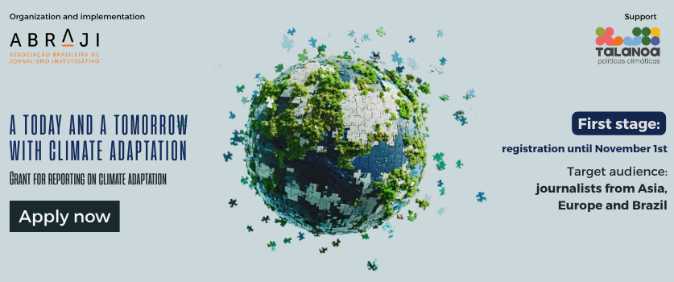
The Brazilian Association of Investigative Journalism (Abraji) and Instituto Talanoa are launching the project "A Today and a Tomorrow with Climate Adaptation," a program to encourage journalistic coverage on climate adaptation, one of the central pillars of the COP30 agenda, taking place in November in Belém (PA). The initiative includes nine reporting grants and training for journalists from all over Brazil with international partners.
Why talk about climate adaptation?
Climate adaptation involves policies, technologies and practices to better deal with the impacts of climate change already underway, such as extreme events, prolonged droughts, floods, water crises and food security issues. Unlike mitigation, which aims to reduce greenhouse gas emissions, adaptation focuses on dealing with and increasing the resilience of communities, cities and economic sectors in the face of the risks and impacts of climate change.
According to the IPCC, the United Nations Intergovernmental Panel on Climate Change, each additional degree of warming increases adaptation costs and deepens social inequalities. Strengthening journalism in this field is essential to ensure that the population has access to reliable information and can monitor, with transparency and in a qualified manner, the policies and solutions aimed at strengthening our adaptation to a climate that has already changed.
The Brazilian Association of Investigative Journalism (Abraji) is a non-profit organization founded in 2002 with the mission of strengthening journalism and democracy through professional training, the defense of press freedom, and access to public information. Over more than two decades, Abraji has become one of the leading references in investigative journalism in Latin America, bringing together thousands of professionals, offering training programs and events — including the country’s largest journalism conference — and leading initiatives that expand transparency and journalists’ investigative capacity. The organization also plays a strong role in areas such as journalist protection, innovation, open data, and environmental reporting, with nationally and internationally recognized projects.
Instituto Talanoa has experience in climate policies, diplomacy and, especially, in efforts to strengthen the adaptation agenda. Notable achievements include articulations with civil society and public authorities. In February, for example, the institute brought together experts from around the world in Brasília to discuss elevating the climate adaptation agenda as a priority at COP30 and delivered into the hands of the president of the Belém conference, André Corrêa do Lago, a letter gathering a series of proposals that should be consolidated at the next UN Climate Conference. Additionally, Talanoa coordinates a network that brings together more than 40 organizations in Latin America and has joined forces for climate diplomacy on adaptation. The letter calling for the tripling of adaptation financing that was delivered to political leaders at the Pre-COP is an example of this. Learn more at https://institutotalanoa.org/sobre/
Two phases of reporting grants
The call has two selection phases:
First phase — Applications until November 7, 2025. Three reporting grants will be selected for journalists who will be in Belém during COP30, with publications planned for the event period (preferably by November 21). The result of this first selection should be announced by November 5. The first phase is aimed at journalists who will already be in Belém and involved in covering the climate conference. Interviews can be conducted during COP30, for example.
Second phase — Applications until December 7, 2025. Six additional reporting grants will be awarded for coverage and publications by the end of February 2026, about the results of the adaptation agenda at COP30 and how they relate to the national and local policies of the grantees' countries.
The selection is open to journalists from countries in Brazil, Europe and Asia and applications can be submitted in Portuguese or English.
Each grant is worth R$ 5,500 for reports in Brazil and US$ 1,000 for international reports, and includes specialized technical mentorship, editorial support and access to specialists. Selected applicants will have structured editorial support.
The reporting grants are aimed at national-scope journalistic media outlets or freelancers who work for these outlets. The focus is to disseminate these adaptation concepts with practical examples to the general public, so preference will be given to newspapers, websites, TV stations and similar national and international-scope outlets.
Priority themes for the reports (see the call for more details)
- The adaptation agenda in climate negotiations/COP30
- Financing for the adaptation agenda
- National and/or local adaptation policies
- Territorial adaptation solutions linked to political priorities
There will be nine reporting grants - three for Brazil, three for countries in Asia, and three for countries in Europe. The topics of the reports can reflect the realities of each country.
Technical training webinar
In addition to the grants, the project will have training on climate adaptation, held in October. The objective is to offer practical and in-depth knowledge for journalists interested in the topic, including those who are not selected for the grants.
During the event, specialists from Talanoa and Abraji will present fundamental technical concepts, data and materials for qualified environmental coverage, in addition to explaining the rules and deadlines of the call. The webinar will also be recorded and made available later.
Check out the training courses available in Portuguese and English.
🗓️ Summary schedule
- Launch of call: October 15 (or adjust the date)
- Launch webinar and training: October 27 - 4pm-6pm - on Abraji's YouTube - https://www.youtube.com/@Abraji_
- Closing of 1st phase applications: November 7, 2025
- Publication of 1st phase reports: preferably by November 21, 2025
- Closing of 2nd phase applications: December 7, 2025
- Publication of 2nd phase reports: by February 27, 2026
✍️ Applications
Applications must be submitted by professional journalists (freelancers or contracted), individually or in pairs. Proposals must contain:
detailed description of the story
- execution timeline
- basic budget
- letter of commitment for publication issued by a journalistic outlet (which can be delivered at the time of application or up to three business days after pre-selection)
The selection will consider journalistic relevance, originality, thematic adherence, social impact and regional diversity.
Check the call here: https://abraji.org.br/publicacoes/call-for-applications-reporting-grants-a-today-and-a-tomorrow-with-climate-adaptation
Registration link: https://forms.gle/tiZ4xVh31caCKoRp8
